I put off Mistborn Era 2 for months. I’d just finished Hero of Ages, Sazed’s revelation was still rattling around in my head, and I wanted more of that. More dark fantasy, more Allomantic heist energy, more Vin being Vin. Then I found out that Era 2 is basically a Western with guns and buddy-cop humor, and I thought: that’s not what I signed up for.
So I read Warbreaker first. Then Stormlight (up until Rhythm of War, at the time). Then I ran out of excuses.
I’ll be honest: Era 2 is a tonal shift. It’s lighter, shorter, and deliberately different from Era 1. If you go in expecting more of the same, you’ll bounce off The Alloy of Law within fifty pages. But if you know what you’re actually getting into – what changes, what stays, and why it matters for the Cosmere – it’s one of the most rewarding parts of Sanderson’s entire catalogue.
This is what I wish someone had told me before I started. Not just the reading order (you can get that from a Google search), but what Mistborn Era 2 actually is, whether it’s worth your time, and why The Lost Metal might be the most important Cosmere book you haven’t read yet. And if you’ve just finished Era 1 and you’re weighing all your options, I also have a guide on what to read after the original Mistborn trilogy.
What Is Mistborn Era 2?
Mistborn Era 2 – also called the Wax and Wayne series – is set about 300 years after The Hero of Ages. Scadrial has moved on. There are trains, electricity, newspapers, skyscrapers, and guns. Lots of guns. The Final Empire’s medieval darkness has been replaced by something closer to a 19th-century industrial city, and the story follows a lawman-turned-nobleman named Waxillium Ladrian and his irreverent partner Wayne as they solve crimes, unravel conspiracies, and stumble into Cosmere-level problems.
If that sounds like a big genre shift, it’s because it is. And that’s precisely the part most people aren’t prepared for.
How Era 2 Is Different from Era 1
Era 1 is an epic fantasy heist that escalates into a world-ending conflict. Era 2 is a detective series with action set pieces and a much smaller scope – at least at first. The books are shorter (300–500 pages versus Era 1’s 600–700+), the tone is lighter, and there’s actual comedy. Wayne alone is responsible for half of it.
And like I said: this threw me off initially. I came in wanting the weight of the Final Empire and got something that felt almost casual by comparison. But that’s a feature, not a bug. Sanderson uses the lighter tone to explore different things: political corruption, religious identity, the ethics of vigilante justice. It’s still Mistborn, just a different spin on it.
The Wax and Wayne Dynamic
Wax and Wayne are not Vin and Kelsier, and honestly, they’re not even trying to be. Wax is a gunslinging Twinborn with a rigid moral code and a complicated relationship with nobility. Wayne is… Wayne. He’s a disguise artist, a compulsive trader (he always leaves something behind when he takes something), and the kind of character who makes you laugh on one page and gut-punches you on the next. Oh, and he’s also a Twinborn! (I love Wayne.)
Their dynamic carries the series. Where Vin and Kelsier had a mentor-student intensity, Wax and Wayne have the kind of partnership built on decades of history, mutual trust, and relentless bickering. It works!
Mistborn Era 2 Books in Order
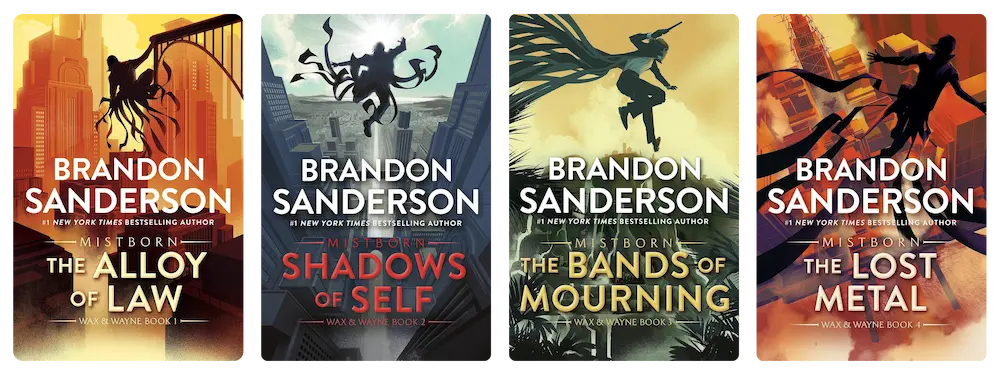
There are four books in Mistborn Era 2, and they should be read in publication order:
- The Alloy of Law (2011) – The shortest and lightest entry. Sanderson originally wrote it as a side project between finishing the Wheel of Time and starting Stormlight, and it has that energy – fun, breezy, lower stakes. Don’t judge Era 2 by this book alone.
- Shadows of Self (2015) – This is where the series finds its footing. The stakes get personal, the tone darkens, and Sanderson proves this isn’t just a side project.
- The Bands of Mourning (2016) – The scope expands significantly. You’ll start seeing how Era 2 connects to the wider Cosmere, and the ending will make you very impatient for the next book.
- The Lost Metal (2022) – The payoff. Everything converges. If you’ve read other Cosmere works, this is where it all starts clicking together in ways that are very satisfying.
Where does Mistborn: Secret History fit? The safe answer is after The Bands of Mourning – reading it earlier risks spoiling a major reveal. Secret History is included in the Arcanum Unbounded collection, and in my Cosmere reading order I actually recommend reading Arcanum Unbounded before starting Era 2 entirely. That way you don’t have to split up a collection mid-series, which gets confusing fast in the already sprawling Cosmere reading order. Either approach works – just don’t read Secret History before Bands of Mourning if you’re going book by book.
When to Read Mistborn Era 2
This is one of the most common questions in Cosmere communities, and the answer has more layers than most guides let on.
Should You Read Mistborn Era 2 Before Stormlight?
Here’s what makes this question tricky: chronologically, Era 2 takes place after the first five Stormlight books. Brandon Sanderson has confirmed that the Wax and Wayne series sits in the ten-year gap between Stormlight 5 and the upcoming Stormlight 6. So in terms of the Cosmere timeline, Stormlight’s first arc comes first.
But reading order and chronological order aren’t the same thing. You can read Era 2 before Stormlight, after Stormlight, or somewhere in between; the main plots don’t depend on each other. I read most of Stormlight first and Era 2 later, and that worked fine.
What does matter is this: there’s a thread that runs through Mistborn Secret History, certain Stormlight scenes, and Era 2’s later books. You’ll pick up on it regardless of order, but the more Cosmere context you bring to each book, the more connections you’ll catch. It’s one of those things where rereads keep rewarding you. I’ve gone back to scenes in Stormlight and Era 2 that I originally read as self-contained moments, only to realise they were part of something much bigger.
For a quick recommended path: Era 1 → Warbreaker → Era 2 → Stormlight. But honestly, the “wrong” order doesn’t ruin anything. It just changes which connections surprise you first. I go into the reading order of all the Cosmere works in my Cosmere reading order.
The Lost Metal Is a Special Case
The first three Mistborn Era 2 books work fine with just Era 1 as background. The Lost Metal is different. That book pulls in characters, magic systems, and plot threads from across multiple Cosmere worlds. Things that seem like soft magic or unexplained phenomena are actually established hard magic systems from other series; you just need the context to recognise them. The more you’ve read beforehand, the more rewarding it is. Even I didn’t catch everything on my first read.
If you’re planning to read The Lost Metal and want to be prepared, I’d recommend having at least Era 1, Secret History, and Stormlight under your belt. Warbreaker and Elantris help too. It’s one of the most Cosmere-interconnected books Sanderson has written, and believe me: it’s worth going in prepared.
Can You Skip Mistborn Era 2?
Technically, yes. Stormlight works as its own series. But if you care about the Cosmere as a connected universe – which is half the fun of reading Sanderson – I wouldn’t. Era 2 is where things start converging. The Lost Metal introduces elements that are clearly building toward the Cosmere’s endgame, and skipping it means missing some of the most important setup for where this whole saga is heading.
How the Magic System Expands
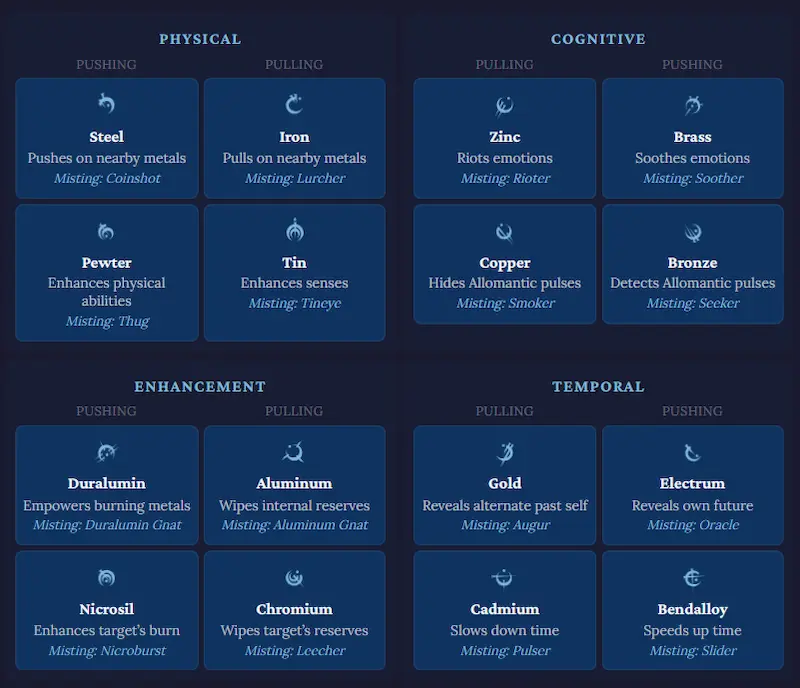
One thing that surprised me about Era 2 is how much the metallic arts grow. In Era 1, Allomancy felt complete: eight basic metals, two god metals, a clean system. Era 2 blows that open.
From 8 Metals to 16
The Allomantic table has doubled. Era 2 introduces eight new metals that were unknown or inaccessible during the Final Empire, each with their own Allomantic and Feruchemical applications. Sanderson gets creative with these – the combinations and tactical uses are far more varied than Era 1’s relatively straightforward push/pull dynamics. I cover all 16 metals and their abilities in my interactive metallic arts guide, if you want the full breakdown.
Twinborns: Allomancy Meets Feruchemy
In Era 1, Allomancers and Feruchemists were separate populations. Era 2 introduces Twinborns: people who have one Allomantic power and one Feruchemical power. The combinations are where things get interesting. A character who can push on metals (Allomancy) while storing weight (Feruchemy) can do things that neither ability could achieve alone. Wax is a perfect example: his steel Allomancy and iron Feruchemy make him a terrifyingly mobile fighter.
This is the kind of thing that makes me very curious about Era 3, which is supposedly set in a 1980s-esque period with computers and modern technology. How do the metallic arts interact with that?
Which Era 1 Characters Appear in Era 2?
This is one of the most searched questions about Era 2, and I get it. You spent three books with these people; you want to know if they show up. Without spoiling how or in what capacity:
Sazed is the most prominent. By the end of Hero of Ages, he became Harmony – and in Era 2, Harmony is an active presence. Seeing what Sazed has become after 300 years, and the weight of what he’s carrying adds a completely different dimension to a character you thought you already understood.
Marsh is around. Three centuries of hemalurgic spikes will do things to a person. His role is smaller but meaningful, and the way people in Era 2 react to him tells you a lot about how the world has changed.
Hoid appears, because Hoid always appears. If you’ve been tracking him across the Cosmere, you’ll catch him. If you haven’t, you’ll probably meet him without realising who he is (which is very on-brand for Hoid).
As for others from Era 1: I won’t say more than that some names echo forward in ways you won’t expect. Part of Era 2’s emotional texture is discovering how these characters left their mark on a world that’s had 300 years to mythologise them. The religions, the legends, the statues; it all traces back to people you watched make those choices in real time.
The Cosmere Payoff: Why Mistborn Era 2 Matters
I’ve already hinted at this, but it deserves its own section: Mistborn Era 2 is where the Cosmere stops being a collection of standalone series and starts becoming one story.
The first three books build toward this gradually. You’ll notice references, catch a familiar name, spot something that doesn’t quite fit the Scadrial you know. But The Lost Metal is where Sanderson pulls the trigger. Characters from other worlds show up. Magic systems you’ve seen on other planets interact with Allomancy and Feruchemy in ways that are logically consistent with their established rules; it’s not soft magic, it’s multiple hard magic systems colliding on the same page.
That’s the thing that made me sit up straight while reading. Sanderson has spent decades building these individual systems with rigorous internal logic, and Era 2 is where he starts combining them. If you’ve read broadly across the Cosmere, those moments hit like revelations. If you haven’t, they still work as story beats, you just won’t feel the full weight behind them.
This is also why I’m so curious about where Sanderson takes things next. Era 3 is planned for a 1980s-esque setting with computers and modern technology. The metallic arts interacting with an industrialised, connected world? After seeing what Era 2 does with a 19th-century setting, the possibilities are staggering to say the least!
In Short: Quick Answers
Is Mistborn Era 2 good?
Yes. The first book is the weakest entry, but from Shadows of Self onward the series finds its footing and doesn’t let go. By The Lost Metal, it’s some of Sanderson’s best work.
Is Mistborn Era 2 as good as Era 1?
It’s a different kind of good. Era 1 has the epic scope and the devastating ending. Era 2 has tighter plotting, better humour, and a more creative magic system. If you go in expecting Era 1 again, you’ll be disappointed; if you let it be its own thing, you might end up preferring it.
How many books are in Mistborn Era 2?
Four: The Alloy of Law, Shadows of Self, The Bands of Mourning, and The Lost Metal. The series is complete.
Why is Mistborn Era 2 so short?
Sanderson originally wrote The Alloy of Law as a side project between major releases, and the shorter format stuck. The books range from about 300 to 500 pages. Personally, I think the pacing benefits from it; there’s very little filler.
Is Mistborn Era 2 worth reading?
If you’re reading this article, probably yes. The tonal shift is real, but the magic system expansion, the character work, and especially the Cosmere connections make it essential reading for anyone who cares about where Sanderson’s larger story is going.
The Adjustment Is Worth It
I started this article by telling you I put off Era 2 for months. I wanted more of Era 1, and the idea of a Western with buddy-cop humour didn’t sound like what I was looking for.
I was wrong. Not because Era 2 is secretly the same as Era 1 – it’s not – but because the things that make it different are the things that ended up making it great. Wayne made me laugh harder than any Sanderson character ever has. The expanded magic system reminded me why I fell in love with Allomancy in the first place. And The Lost Metal gave me the kind of Cosmere moments where you put the book down and just stare at the ceiling for a while.
Give it the chance I almost didn’t. I promise you won’t regret it.