So, you finished the Wheel of Time. All fifteen books. 11,898 pages. Roughly 463 hours of audiobook if you went that route. You watched Rand go from a shepherd in the Two Rivers to… well, you know. And now you’re sitting there, staring at your bookshelf (or your e-book library, or your audiobook credits), feeling that very specific emptiness that only comes from finishing a series that consumed months of your life.
I know this feeling intimately. When I turned the last page of A Memory of Light, I didn’t immediately reach for another book. I just sat there for a while. The Wheel of Time had been my constant companion through a long stretch of my life, and suddenly it was gone. The world kept turning, but the Wheel had stopped.
And then I did what you’re doing right now: I Googled “books like the Wheel of Time.” Books similar to Wheel of Time. What to read after Wheel of Time. You know the search.
Here’s the problem with every list I found: they all treat WoT fans like we’re one group. “Oh, you liked the Wheel of Time? Here’s a numbered list of epic fantasy series.” But that misses the point entirely. The person who fell in love with the One Power – the gendered channeling, the rules of saidin and saidar, the way the magic system made sense – wants a completely different book than the person who lived for Aes Sedai politics and Daes Dae’mar. And both of those readers want something different from the person who just loved watching Rand, Perrin, and Mat grow from village boys into legends.
So I did something none of those lists do: I grouped these 12 series by what you actually loved about WoT. Jump to your section. Find what scratches your specific itch.
One more thing. If you’ve read my other articles, you know my rule: I don’t recommend books I haven’t read. Every series on this list is something I’ve personally picked up; where I haven’t finished a full series yet, I’ll tell you exactly how far I’ve gotten. No faking it. No filler recommendations scraped from “best fantasy books” lists. Just honest takes from someone who’s been where you are.
But first: let’s acknowledge what you just accomplished.
The Wheel of Time Series at a Glance
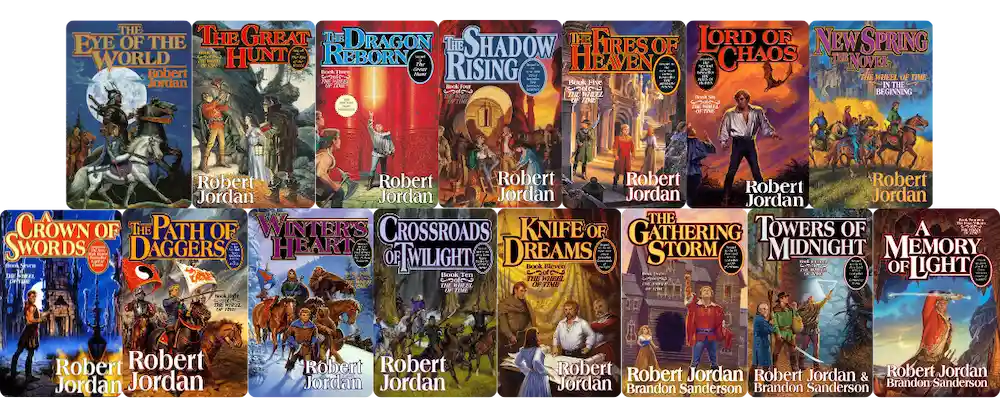
| # | Book | Pages | Audiobook |
|---|---|---|---|
| 1 | The Eye of the World | 782 | 29h 57m |
| 2 | The Great Hunt | 681 | 26h 34m |
| 3 | The Dragon Reborn | 675 | 24h 48m |
| 4 | The Shadow Rising | 981 | 41h 13m |
| 5 | The Fires of Heaven | 963 | 36h 27m |
| 6 | Lord of Chaos | 987 | 41h 32m |
| — | New Spring (prequel) | 334 | 12h 38m |
| 7 | A Crown of Swords | 856 | 30h 24m |
| 8 | The Path of Daggers | 672 | 23h 25m |
| 9 | Winter’s Heart | 766 | 24h 12m |
| 10 | Crossroads of Twilight | 822 | 26h 04m |
| 11 | Knife of Dreams | 837 | 32h 19m |
| 12 | The Gathering Storm | 766 | 33h 02m |
| 13 | Towers of Midnight | 864 | 38h 23m |
| 14 | A Memory of Light | 912 | 41h 55m |
| – | Total | 11,898 | ~463 hours |
Yeah. You read all that. Even the slog. Give yourself some credit – you earned the right to be picky about what to read after Wheel of Time.
If You Loved the Magic System
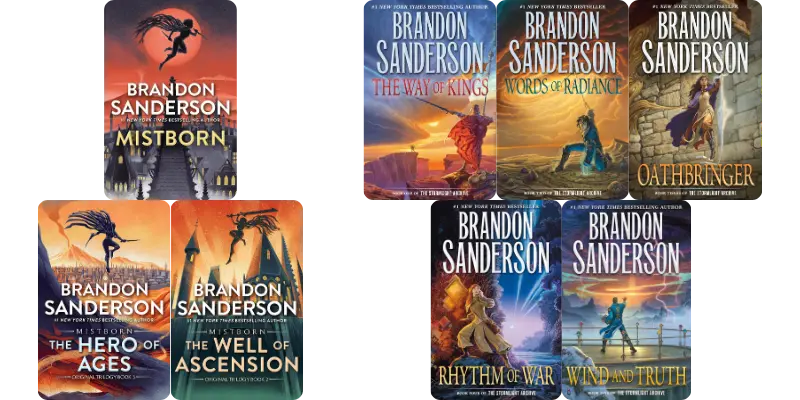
The One Power. Gendered channeling. Saidin and saidar. Rules that matter.
Let’s be honest: one of the most satisfying things about the Wheel of Time is that the magic makes sense. You learn how channeling works, you understand the weaves, you know why men go mad and women don’t. When Rand figures out a new technique or Nynaeve Heals something that shouldn’t be Healable, it lands because you understand the system well enough to appreciate what just happened.
If that’s what hooked you, you want Brandon Sanderson. And yes, I know: two Sanderson picks in one section. But nobody does hard magic like the guy who literally finished writing the Wheel of Time.
Mistborn by Brandon Sanderson (3 books – complete)
Allomancy might be the single most elegant magic system in fantasy. Swallow a metal, burn it, get a specific power. Steel lets you Push on metals, tin enhances your senses, pewter makes you stronger. Every ability has clear rules, clear costs, and clear limits – and Sanderson builds his entire plot around what happens when clever people exploit those rules in ways you didn’t see coming.
The reason Mistborn works as a WoT follow-up isn’t just the hard magic, though. It’s Sanderson himself. Robert Jordan handpicked him (well, Harriet did) to finish the Wheel of Time, and the fact that he pulled it off – writing the last three books with enough respect for Jordan’s vision while bringing his own strengths – tells you everything about how well he understands what makes these systems tick.
But fair warning: Mistborn is not WoT in scope. It’s three books, mostly set in one city, with a smaller cast. Think of it less as “the next Wheel of Time” and more as “the most satisfying magic system you’ll encounter after the One Power.” And if it hooks you? Welcome to the Cosmere. That’s where the real scope lives.
I wrote a whole guide on what to read after you finish Mistborn, because the “what now?” paralysis hits there too.
The Stormlight Archive by Brandon Sanderson (5 books – first arc complete, second arc planned)
If Mistborn is Sanderson’s tight, elegant magic showcase, Stormlight is where he goes full Wheel of Time. And I mean that literally: multiple POV characters, a continent at war, an ancient evil returning, a magic system (Surgebinding) that reveals new layers with every book, and a scope that makes your head spin. This is Sanderson writing the kind of epic he fell in love with when he read WoT as a teenager – and you can feel it on every page.
Surgebinding scratches the same itch as channeling. Knights Radiant bond spren to gain access to Surges – pairs of fundamental forces like Gravitation and Adhesion. Each order has different abilities, different oaths, different rules. And just like with the One Power, Sanderson gives you enough information to predict what’s possible before characters figure it out. That moment when you realize what Kaladin can do with a Full Lashing before he does? That’s the feeling.
Now, WoT isn’t absent on mental health – Rand’s descent into madness, the voices in his head, the weight of destiny nearly breaking him on Dragonmount – that’s absolutely a mental health arc. But Jordan threads it through one character’s storyline. Sanderson makes it the central theme across almost every POV. Kaladin’s depression, Shallan’s identity fracturing, Dalinar’s alcoholism and guilt – these aren’t subplots, they’re the engine driving everything. If Rand’s darkest moments were the parts of WoT that hit you hardest, Stormlight lives in that space permanently.
The first five books complete a full arc, so you’re not left hanging. But be warned: once Stormlight gets its hooks in you, you’ll want the full Cosmere reading order. And then you’ll understand why people keep comparing Sanderson to Jordan – not as an imitator, but as a worthy successor. I’ve also written about whether to start with Mistborn or Stormlight if you’re unsure which to pick up first.
If You Loved the Chosen One & Prophecy
The Dragon Reborn. Ta’veren. The Pattern weaving destiny. Free will vs fate.
Rand al’Thor’s arc is one of the great chosen one stories in all of fiction. Not because he fulfills the prophecy – plenty of fantasy characters do that – but because of the tension. The Karaethon Cycle says the Dragon Reborn will save the world and break it. The Aiel prophecies say something slightly different. The Seanchan have their own version. And Rand spends fourteen books caught between all of them, slowly being crushed by the weight of a destiny he didn’t choose, going half-mad from saidin, hearing a dead man’s voice in his head, until he nearly destroys everything on Dragonmount before pulling himself back.
If that’s the thread that kept you turning pages, these two series understand the assignment.
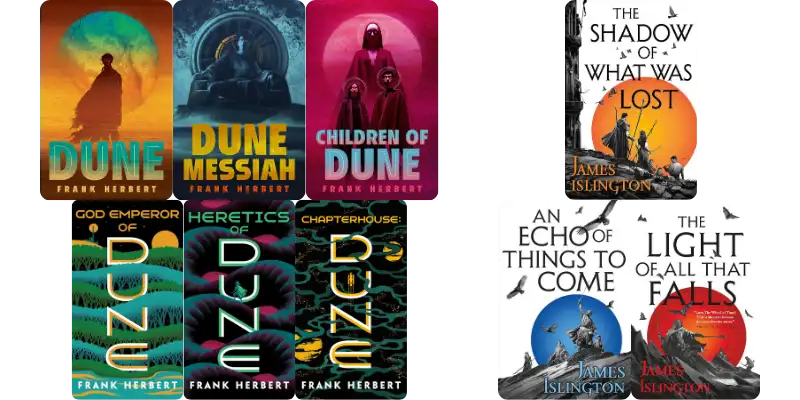
Dune by Frank Herbert (6 books – complete, though most read book 1)
Paul Atreides is Rand al’Thor’s spiritual cousin, and I don’t think that’s a coincidence. A young man from the edges of civilization, thrust into a messianic role by prophecies he didn’t ask for, gaining followers who see him as a savior while he wrestles with what that actually means. The parallels are almost eerie.
But here’s what Dune does that WoT doesn’t: it questions the prophecy itself. Where Jordan’s Pattern is real and the Dragon Reborn genuinely is destined to face the Dark One, Herbert asks a more unsettling question – what if the prophecy was manufactured? What if an organization deliberately seeded religious myths across planets to be exploited later? Paul knows this, and he fulfills the prophecy anyway, because by the time he understands the trap, he’s already inside it.
Fair warning: Dune is sci-fi, not fantasy. The prose is denser, more philosophical, and the pacing is slower. There’s less action and more internal monologue about politics and religion. The series also gets increasingly strange after book 1 – and I’m being diplomatic. I’ve read the first book; it’s brilliant. If the chosen one tension was your thing in WoT, Dune hits that nerve harder than almost anything else I’ve encountered.
The Licanius Trilogy by James Islington (3 books – complete)
This might be the most Wheel-of-Time-like series currently in existence. I’m not exaggerating. Augurs who can see the future but are distrusted by society (hello, channelers). An ancient dark force sealed away that’s starting to break free (hello, Dark One). A group of young people at a school discovering they have powers they don’t understand (hello, Two Rivers kids at the White Tower). A web of prophecies that characters are trying to fulfill or escape.
Islington clearly grew up on Jordan and Sanderson, and he wears those influences proudly. The Licanius Trilogy feels like someone took the bones of WoT – prophecy, a magic system with rules, a dark power threatening to unravel reality – and rebuilt it in three tight books instead of fourteen. The focus here is on time manipulation and predestination, and the way the trilogy handles the question of “can you change a future that’s already been seen?” is genuinely clever.
I’ve read the first book, The Shadow of What Was Lost, and it scratched the WoT itch immediately. The fantasy community consistently ranks Licanius as one of the closest things to Wheel of Time you can find, and based on book one, I understand why. Three books, all published, no waiting. If you want a book series like Wheel of Time without committing to another decade-long series, start here.
If You Loved the Epic Scope & Worldbuilding
Hundreds of characters. Deep cultures. A world that feels lived-in for thousands of years.
Part of what makes the Wheel of Time special is that it doesn’t feel invented. The Aiel have a complete culture – customs, honor codes, a history of being pacifists forced into becoming warriors. The Seanchan have their own civilization with its own logic. Andor, Cairhien, Tear, Illian – these aren’t just names on a map, they’re places with distinct politics, architecture, and attitudes toward channelers. Jordan built a world that feels like it existed for thousands of years before page one.
If that sense of depth and scale is what you’re chasing, these two need no introduction. But they deserve one anyway.
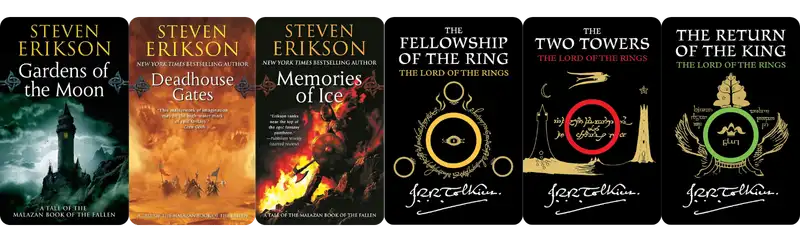
Malazan Book of the Fallen by Steven Erikson (10 books – complete)
I need to be upfront: Malazan is the only series I’ve read that makes the Wheel of Time look small. And I’ve read all ten books, so I’m not saying that lightly.
Where Jordan gives you a world with a few thousand years of recorded history, Erikson gives you three hundred thousand years. Civilizations have risen and fallen so many times that the current characters are walking on the ruins of ruins. The magic system (Warrens – paths of sorcery tied to elemental forces and elder gods) operates on a scale that makes the One Power feel almost cozy. And the cast makes WoT’s look modest – you’ll meet hundreds of named characters across multiple continents, timelines, and planes of existence.
But here’s the thing everyone warns you about, and they’re right to warn you: Erikson does not hold your hand. Gardens of the Moon drops you into the middle of a military campaign with no prologue, no world-building exposition, no “this is how magic works” explanation. Characters reference events, places, and powers you won’t understand for books. I bounced off it the first time. Came back a year later, pushed through, and by Deadhouse Gates I was completely hooked. By The Crippled God, I was wrecked in a way that only A Memory of Light had managed before.
If you survived the Wheel of Time slog, you can survive Gardens of the Moon. And the payoff is worth it. I’ve written a Malazan beginner’s guide and detailed summaries for Gardens of the Moon, Deadhouse Gates, and Memories of Ice if you want backup on the journey.
The Lord of the Rings by J.R.R. Tolkien (3 books – complete)
I almost didn’t include this one because, well, you’ve probably already read it. But I’d be doing you a disservice to leave it off, because the Wheel of Time doesn’t exist without Tolkien – and I mean that literally.
The Two Rivers is the Shire. Rand’s journey from village boy to world-shaper follows Frodo’s template. The Dark One is Sauron with a different coat of paint. Jordan was open about building on Tolkien’s foundation; the first hundred pages of The Eye of the World are almost deliberately Hobbit-esque before the story finds its own identity.
So if, somehow, you read all 11,898 pages of WoT without ever picking up The Lord of the Rings – fix that. And if you have read it, consider a reread. Coming back to Tolkien after Jordan is a different experience. You’ll notice the echoes everywhere, and you’ll appreciate both more for it.
If You Loved the Political Intrigue
Aes Sedai scheming. The White Tower. Nations maneuvering. The Forsaken playing chess with kingdoms.
Not everyone reads WoT for the battles and the magic. Some of you – and I see you – read it for the scheming. The Aes Sedai factions jockeying for control of the White Tower. Elaida’s coup. The Forsaken playing three-dimensional chess with entire kingdoms as pieces. Daes Dae’mar, the Great Game, where Cairhienin nobles communicate through the placement of a wine cup. If those were the chapters that made you sit up straighter, these two series live in that space.
Fair warning: both of these are darker and more cynical than WoT. Jordan’s world ultimately believes in good triumphing. These don’t.
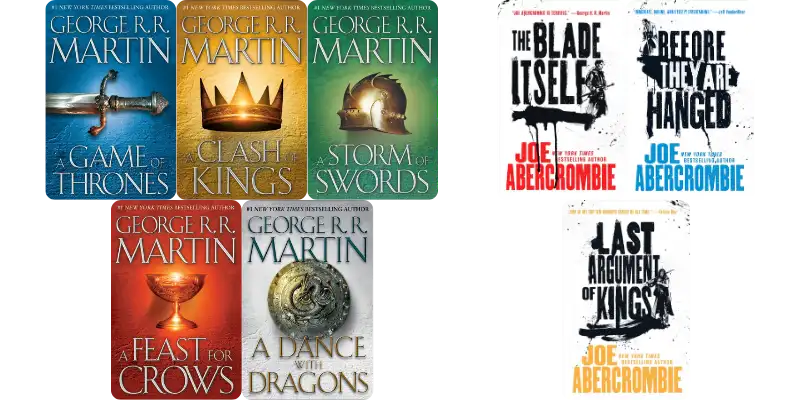
A Song of Ice and Fire by George R.R. Martin (5 books – INCOMPLETE)
Take the Aes Sedai political scenes and extend them across an entire series. That’s A Song of Ice and Fire. Every character has an agenda. Every alliance is temporary. Every act of honor gets punished, and every act of cunning gets rewarded – until it doesn’t. If Daes Dae’mar was your favorite element of WoT, Martin turned it into a five-thousand-page epic.
The first book, A Game of Thrones, is some of the best political fantasy ever written. The way Martin constructs his POV chapters – each character seeing the same events from completely different angles, each one believing they’re the hero of the story – is masterful. I’ve read it, and the Ned Stark arc alone rewires how you think about fantasy protagonists.
But I have to be honest about two things. First: this series is not finished. Five books are out, the sixth has been “coming soon” for over a decade, and there’s a real chance it never gets completed. If the wait between Wheel of Time books frustrated you (and those did get finished), know what you’re signing up for. Second: I’ve only read book one. It’s enough to recommend confidently, but I can’t speak to where the series goes from there.
If the incomplete status is a dealbreaker, skip straight to the next pick. No judgment.
The First Law by Joe Abercrombie (3 books – complete, plus standalones + sequel trilogy)
Here’s a question: what if Moiraine wasn’t a good person? What if she was manipulating everyone not to save the world, but to consolidate her own power? And what if the story knew that and didn’t pretend otherwise?
That’s Bayaz, First of the Magi. On the surface, he’s the wise wizard guiding a group of reluctant companions on a quest. Sound familiar? But Abercrombie uses that familiar structure to pull the rug out from under every fantasy trope Jordan played straight. The barbarian hero is a broken man who can barely function. The noble captain is a narcissist. The wizard is the most dangerous person in the room, and not in the way you’d hope.
The political layers here are incredible. The Union’s internal power struggles – the king’s court, the Inquisition, the banking houses, the military command structure all pulling in different directions – have that same White Tower energy where everyone is technically on the same side but functionally at war with each other.
I’ve read The Blade Itself and Before They Are Hanged, and am currently working through Last Argument of Kings. The political complexity hooked me immediately. But I want to be clear about tone: this is the opposite of WoT’s warmth. Jordan believed in heroes. Abercrombie doesn’t. If you loved WoT’s political intrigue but also loved its ultimately hopeful worldview, First Law will challenge you. Consider that both a warning and a recommendation.
If You Loved the Military Campaigns & War
Dumai’s Wells. The Last Battle. The Seanchan. Tarmon Gai’don. Armies clashing on a continental scale.
There’s a moment in Lord of Chaos – you know the one – where the Asha’man arrive at Dumai’s Wells and Rand’s command changes everything. “Asha’man, kill.” Two words, and the battle goes from desperate to devastating. That scene isn’t just exciting; it reframes the entire series. Suddenly the power dynamics of the world shift, and you realize the wars in WoT aren’t just backdrop – they’re the story changing shape.
If those moments are what you lived for – the military escalation, the tactical stakes, the sense that war has consequences that reshape the world – these two picks go even harder.
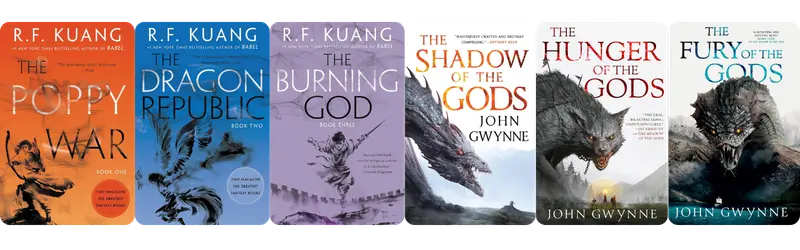
The Poppy War by R.F. Kuang (3 books – complete)
This trilogy wrecked me, and I mean that as the highest compliment.
The Poppy War starts as a military academy story – Rin, an orphan from the south, tests into the most elite school in the empire. So far, so familiar. But then war breaks out, and the story escalates with a speed and brutality that makes WoT’s darkest moments look gentle. The progression from “school story” to “total war” mirrors WoT’s own escalation from “village adventure” to “apocalyptic battle” – except Kuang does it in three books instead of fourteen, and she doesn’t flinch from anything.
The magic system is tied to shamanism and the gods themselves. Rin discovers she can channel the power of the Phoenix – devastating, world-breaking fire – but at a cost that makes the taint on saidin look manageable. Where Rand struggles with the madness of male channeling, Rin struggles with the fact that her power requires her to become something less than human. The parallels are striking, but the choices Rin makes are ones Rand never would.
What makes this a standout recommendation – and one you won’t find on most “books like WoT” lists – is the historical grounding. The Poppy War is based on the Second Sino-Japanese War and the Nanjing Massacre. Kuang is a scholar of East Asian history and literature, and she brings that specificity to the fantasy. The war isn’t abstract here. It’s horrifying, personal, and it doesn’t pretend that battles are heroic. If Dumai’s Wells made you sit up, The Poppy War will keep you awake at night.
The Bloodsworn Saga by John Gwynne (3 books – complete)
If you want WoT’s large-scale battle energy transplanted into a Viking-inspired world, John Gwynne is your guy. The Shadow of the Gods opens with a world where the old gods fought a cataclysmic war, died, and left their remains literally scattered across the landscape – their bones forming mountain ranges, their blood pooling into magical rivers. It’s a world shaped by divine violence, and the mortal characters are still dealing with the fallout.
Multiple POV characters, each entangled in different factions of a simmering conflict, each carrying secrets connected to those dead gods. The structure will feel familiar coming from WoT: separate threads that slowly weave together as the stakes escalate. And the battle scenes are visceral. Gwynne writes combat with a physical intensity that few fantasy authors match – shield walls, axe work, the chaos of a battle line breaking. If WoT’s big moments gave you chills, these will too.
I’ve read The Shadow of the Gods and the battle sequences earned this series its spot. I still need to finish the trilogy – but book one demonstrated exactly the kind of epic, war-driven fantasy that WoT readers crave. Three books, all published, Norse mythology instead of Arthurian – a fresh take on a familiar itch.
If You Loved the Character Growth
Farmboys becoming kings. Nynaeve’s evolution. Egwene’s transformation. Watching people become more than they were.
Here’s what Jordan did better than almost anyone: he let characters change over thousands of pages. Rand starts as a stubborn shepherd and ends as something almost unrecognizable – a man who carries the weight of every death, every hard decision, every sacrifice, and somehow finds a reason to keep going. Nynaeve evolves from an angry village Wisdom to someone who Heals what was thought unhealable. Egwene goes from an innkeeper’s daughter to the most formidable Amyrlin the White Tower has seen in generations.
That kind of slow, earned character transformation – where you look back after two thousand pages and realize someone has become a completely different person – is rare. These two series understand it.
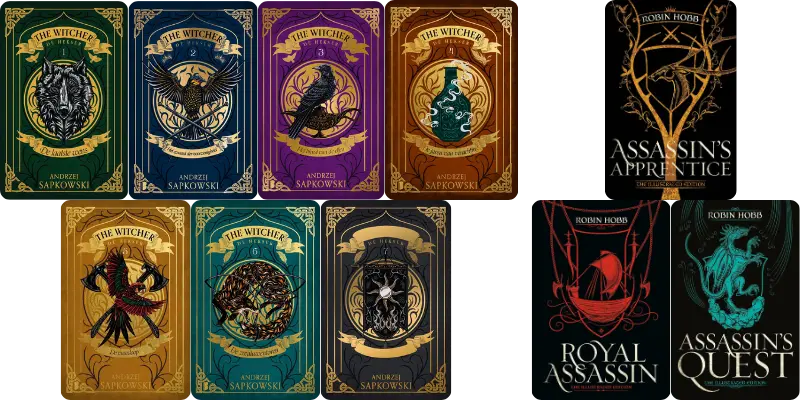
The Witcher by Andrzej Sapkowski (8 books – complete)
I came to The Witcher through the games – about 200 hours of Witcher 3, if we’re being honest – and the books showed me how much more there was to this world. But the reason The Witcher belongs in a WoT conversation isn’t the worldbuilding or the monsters. It’s the found family.
Geralt, Yennefer, and Ciri. A mutant monster-hunter who insists he doesn’t have feelings, a sorceress who’s spent decades building walls around herself, and a girl with a destiny she didn’t choose. Watching these three broken people slowly become a family – not through blood but through choice, loyalty, and shared trauma – is the emotional core of the entire series. It’s the same thing Jordan does with his core cast. Rand, Mat, Perrin, Egwene, Nynaeve – their bonds are forged through suffering and time, and that’s what makes the payoffs land.
The structure is different from WoT: the first two books are short story collections before the saga shifts into a connected novel series. The tone is more cynical – Sapkowski loves moral ambiguity, and Geralt’s world doesn’t have a neat division between Light and Dark. But the character depth is there. Geralt’s evolution from a loner who claims “witchers don’t have emotions” to a man who would burn the world to protect his daughter is one of the best arcs in fantasy.
I’ve read the full series, short stories included. If you want the full reading order, I’ve written a Witcher books guide that covers exactly where to start and why.
The Farseer Trilogy by Robin Hobb (3 books – complete, plus 13 more in the Realm of the Elderlings)
I’m going to be upfront: I’m currently reading Assassin’s Apprentice. So I can’t speak to the full trilogy the way I can with The Witcher or Malazan. But what I’ve read so far has earned its place here, and the fantasy community’s near-universal praise for Hobb’s character work tells me I’m on the right track.
FitzChivalry Farseer is a royal bastard – literally, the illegitimate son of a prince – who gets pulled into court intrigue, trained as an assassin, and saddled with a magical gift (the Wit, a bond with animals) that his society considers an abomination. If that setup sounds like it has Jordan DNA – a young man who didn’t choose his fate, whose abilities mark him as both valuable and dangerous – you’re not wrong.
What Hobb does differently is the intimacy. WoT gives you a sprawling ensemble; Farseer gives you one person, seen from the inside. Fitz’s voice is deeply personal, deeply vulnerable, and – from what I’ve read so far and what the community consistently says – deeply painful. People who love Nynaeve’s stubbornness or Rand’s burden tend to love Fitz. People who found WoT’s character moments more compelling than its battle scenes tend to call Hobb their favorite fantasy author.
The Farseer Trilogy is three books, but it’s the entry point to a much larger world: the Realm of the Elderlings spans sixteen novels across multiple trilogies and series. If WoT’s length was a feature rather than a bug for you, there’s a lot of Hobb to explore. I’ll update this section as I read further – but the early verdict is that the character writing is remarkable, and I understand exactly why this recommendation keeps showing up next to WoT.
Quick Comparison Table
| Series | Author | Books | Complete? | Pages (est.) | WoT Quality Match | Tone |
|---|---|---|---|---|---|---|
| Mistborn Era 1 | Sanderson | 3 | Yes | ~2,200 | Magic system | Hopeful, epic |
| Stormlight Archive | Sanderson | 5 (of 10) | No* | ~5,500+ | Magic + scope | Epic, emotional |
| Dune | Herbert | 6 | Yes | ~3,500 | Chosen one | Philosophical |
| Licanius Trilogy | Islington | 3 | Yes | ~2,100 | Prophecy | WoT-adjacent |
| Malazan | Erikson | 10 | Yes | ~11,000 | Worldbuilding | Dark, military |
| Lord of the Rings | Tolkien | 3 | Yes | ~1,500 | Worldbuilding | Classic, mythic |
| A Song of Ice and Fire | Martin | 5 | No | ~5,000 | Politics | Grimdark |
| The First Law | Abercrombie | 3+6 | Yes | ~3,000+ | Politics | Grimdark, cynical |
| The Poppy War | Kuang | 3 | Yes | ~1,700 | War, military | Dark, brutal |
| Bloodsworn Saga | Gwynne | 3 | Yes | ~1,800 | War, military | Norse, visceral |
| The Witcher | Sapkowski | 8 | Yes | ~2,700 | Character growth | Cynical, warm |
| Farseer Trilogy | Hobb | 3 (16 total) | Yes | ~2,000 | Character growth | Emotional, heavy |
Stormlight is complete for its first arc (books 1-5). Second arc planned.
Frequently Asked Questions
What is the closest book series to Wheel of Time?
It depends on what you loved most. The Licanius Trilogy is the closest in structure – prophecy, a sealed dark force, young people discovering powers, and a magic system with rules. The Stormlight Archive is the closest in scope and ambition, written by the man who finished WoT. And Malazan is the closest in sheer scale, though it’s significantly harder to get into. If I had to pick one: Licanius for the feel, Stormlight for the experience.
Is the Stormlight Archive like the Wheel of Time?
Yes, and it’s not a coincidence. Brandon Sanderson grew up reading WoT, was chosen to finish the series after Robert Jordan’s death, and then went on to write his own epic that clearly draws on what he loved about Jordan’s work. Multiple POV characters, a continent-spanning conflict, a hard magic system with deep rules, and a scope that keeps expanding. The differences are real – Stormlight is more focused on mental health and has different pacing – but if you want the closest spiritual successor to WoT, this is it.
Should I read Malazan after Wheel of Time?
If you loved WoT’s worldbuilding and epic scope: absolutely. Malazan is the only series I’ve read that makes WoT look small. But go in with your eyes open – Gardens of the Moon is famously difficult to start, and Erikson’s style is the opposite of Jordan’s hand-holding. I bounced off it the first time and came back a year later. If you want companion resources, I’ve written a Malazan beginner’s guide and detailed summaries for Gardens of the Moon, Deadhouse Gates, and Memories of Ice.
Are there any completed series like Wheel of Time?
Yes, and most of the series on this list are finished: Malazan (10 books), Mistborn Era 1 (3 books), The Licanius Trilogy (3 books), The Poppy War (3 books), The First Law original trilogy (3 books), The Witcher (8 books), Bloodsworn Saga (3 books), The Farseer Trilogy (3 books), and Lord of the Rings (3 books). The ones to be aware of: A Song of Ice and Fire is famously unfinished, and The Stormlight Archive has completed its first five-book arc but has a second arc planned.
What should I read if I liked the Wheel of Time but want something shorter?
Mistborn Era 1 (3 books, ~2,200 pages) or the Licanius Trilogy (3 books, ~2,100 pages). Both give you that WoT feeling – hard magic, prophecy, a dark force threatening the world – in a fraction of the commitment. You could finish either in the time it takes to get through The Shadow Rising. If you want something even more contained, Dune (book 1 alone, ~700 pages) scratches the chosen one itch beautifully as a standalone.
The Wheel Keeps Turning
Nothing will replace the Wheel of Time. I want to be honest about that. You can read every book like the Wheel of Time on this list – and you should – but none of them will give you exactly what Jordan gave you. That specific blend of hope and scale and depth, that world where every culture feels real and every character earns their ending, those 11,898 pages you lived inside for months – that’s singular.
But here’s what I’ve learned since I finished A Memory of Light and started chasing the same feeling: the void isn’t something to fill. It’s a door. Every series on this list showed me something WoT didn’t. Malazan showed me that fantasy can be even bigger and stranger than I imagined. Mistborn showed me that a tighter story can hit just as hard. The Poppy War showed me that war in fantasy doesn’t have to be noble. And I’m still discovering – Hobb is teaching me things about character that I didn’t know fiction could do.
You read 11,898 pages. You survived the slog. You watched the Last Battle and came out the other side. Whatever you pick up next, you’re bringing all of that with you – and that makes you a better reader than you were before page one of The Eye of the World.
The Wheel of Time turns, and Ages come and pass. But the next Age is yours to choose.
More from Book Nook Cook:
- Malazan Beginner’s Guide – Your complete guide to tackling Erikson’s masterpiece
- Cosmere Reading Order – Navigate Sanderson’s interconnected literary universe
- What to Read After Mistborn – If Sanderson hooked you with Mistborn, start here
- How to Start Reading the Witcher – The full reading order, short stories included
- The Wheel of Time Slog – My survival guide (you already know this one)