The Stormlight Archive characters are the reason I’m still here, 5,000 pages later – and honestly, I didn’t see it coming. I came to this series the way a lot of people do: I’d just finished something enormous (the Wheel of Time, all fourteen books, don’t ask how long it took), I wasn’t ready to stop living inside a giant series, and I’d loved Mistborn Era 1 and Warbreaker enough to trust Sanderson to pull me in again. What I showed up for was the magic systems (incredible as they are), the planet-sized worldbuilding, the storms. What kept me was the people.
Because these characters are doing some real psychological work, in a way I hadn’t seen in epic fantasy before. Each of the major POVs represents something true and uncomfortable: depression, dissociation, addiction, faith that turns out to be a lie, grief you can’t put down. Sanderson didn’t write heroes who happen to have flaws. He wrote the flaws first and built whole people around them.
So this is a guide to every major character worth knowing – who they are, what their arc actually means, and why they stay with you long after you close the book.
One note on spoilers. The main text stays spoiler-light, safe for anyone who hasn’t started or is only partway through book one. Anything past The Way of Kings lives inside a collapsible box you can choose to open (or not, it’s up to you). Quick-reference table first, deep dives after.
The Main Stormlight Archive Characters by Book
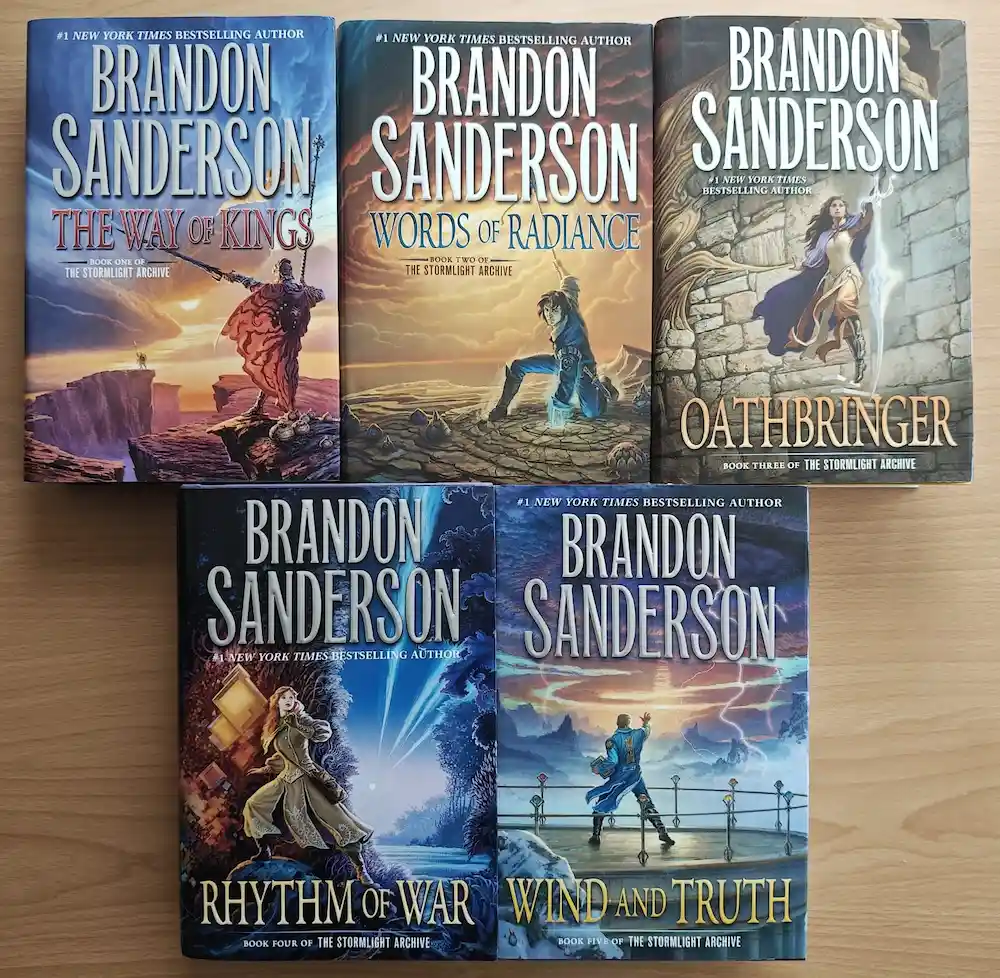
Before the deep dives, here’s the cheat sheet. Each main book in the first arc follows one character through present-day events while flashback chapters slowly peel back their past. This is Sanderson’s signature structure, and it’s a big reason these characters land as hard as they do.
| Book | Primary POV (Flashback Character) | Other Major POVs |
|---|---|---|
| The Way of Kings | Kaladin | Shallan, Dalinar, Szeth |
| Words of Radiance | Shallan | Kaladin, Dalinar |
| Oathbringer | Dalinar | Kaladin, Shallan |
| Rhythm of War | Venli & Eshonai | Navani, Kaladin, Shallan |
| Wind and Truth | Szeth | Kaladin, Shallan, Dalinar, Adolin, Jasnah, Renarin |
Each flashback sequence is basically an origin story told in parallel with the main plot, so by the time you understand who someone was, you understand exactly why they’re breaking (or healing) now. Wind and Truth closes out the first five-book arc; there are five more planned, eventually separated by a time-skip. So yes, you’re signing up for a lot. And if you’re wondering how Stormlight fits into Sanderson’s larger universe… I’ve got a Cosmere reading order article just for that.
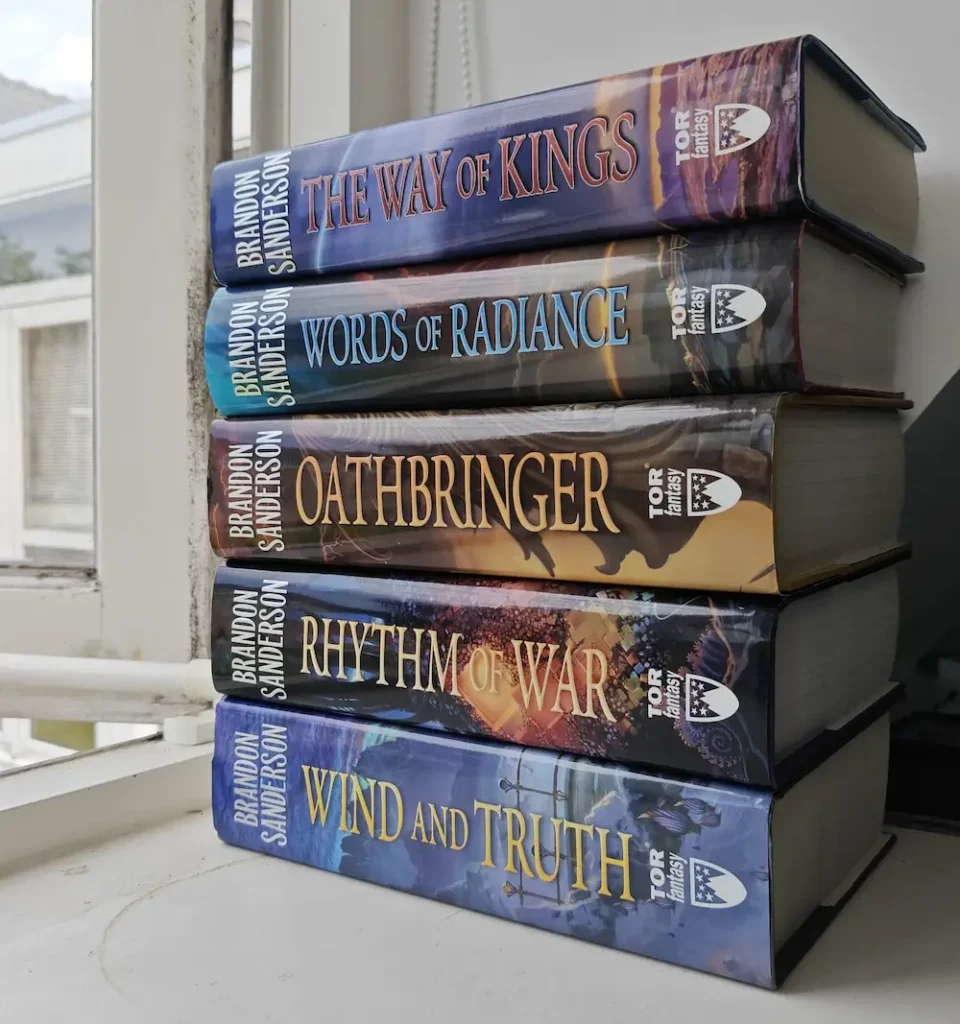
The Five Primary POVs
These five each headline a book in the first arc, and each one is built around a different piece of what it means to be a person. Let’s get into them.
Kaladin Stormblessed – The Weight of Protection
If you only read the first book, Kaladin is the reason you’ll keep going. He’s a surgeon’s son from a backwater town who threw away a comfortable healer’s future to become a soldier, got betrayed by the lighteyed nobility he served, and ended up a branded slave on a bridge crew with a life expectancy measured in weeks. (Bridge crews haul giant wooden bridges across a battlefield so other people can charge over them. Into arrow fire. Yes, it is as grim as it sounds.)
But the war stuff isn’t really what Kaladin is about. Kaladin is about depression – and I’ll be honest, I’ve not seen it written this accurately in fantasy before. Not the “tragic backstory” kind. The real kind: the mornings where getting up feels impossible, the voice quietly insisting everyone would be better off without you, the slow crush of believing it’s your job to please or even save everyone and then losing people anyway. His whole sense of self is built on being the protector, the one who keeps people alive. And the question that breaks him is one a lot of readers will recognise: who are you when you can’t?
What got me is that Sanderson refuses to fix it with a montage. Kaladin doesn’t “get better” because he gets superpowers. He gets the powers and is still depressed, and has to keep doing the work anyway, one day at a time. That’s the part that rings true. (If you’ve ever waited to feel okay before doing the hard thing, only to slowly realise it doesn’t work in that order… yeah, Kaladin gets it.)
And he’s not doing it alone. Early on, Kaladin bonds Sylphrena – Syl, an honorspren with the personality of a delighted, mischievous breeze – and their friendship is the warmth that keeps his whole storyline from sinking. She’s the levity to his gloom, and watching her grow from flighty and half-formed into someone who genuinely gets him is one of the big joys of the series.
Kaladin’s Radiant order, the Windrunners, ties right into all of it. They live by Ideals you have to genuinely mean before you can speak them, and Kaladin’s first one is basically the whole series in a sentence:
“Life before death, strength before weakness, journey before destination.”
– The First Ideal of the Knights Radiant
And the reason it all lands so hard? Mental-health rep in epic fantasy is usually either missing entirely or slapped on for one chapter and forgotten. Kaladin’s isn’t. If you’ve ever carried the weight of feeling responsible for everyone around you, his story is going to hit a nerve – the good kind, the kind that makes you feel seen instead of lectured.
Spoilers: Kaladin’s full arc (The Way of Kings → Wind and Truth)
The Windrunner Ideals basically chart his recovery, and honestly they map onto real progress better than most “healing arcs” I’ve seen in fiction:
- Second Ideal: “I will protect those who cannot protect themselves.” He swears it at the Battle of the Tower: the moment he chooses to save the army that enslaved him.
- Third Ideal: “I will protect even those I hate, so long as it is right.”
- Fourth Ideal: “I accept that there will be those I cannot protect.” This one nearly destroys him, because saying it means letting go of the impossible standard that’s been crushing him for four books. His slave brands literally disappear the moment he means it.
And the resolution that floored me: by Wind and Truth, Kaladin’s job isn’t “soldier” anymore. It’s basically therapist. The guy who started the series unable to save himself ends it helping other broken people learn to survive their own heads. In a genre that loves to solve trauma with a bigger sword, that one landed hard.
Shallan Davar – Identity as Survival
Shallan is the character people argue about the most, but I think most arguments usually don’t go deep enough. On the surface she’s the fun one: a sheltered noble girl from Jah Keved who talks her way into an apprenticeship with the smartest woman on the planet (more on Jasnah later), draws like a camera, and fires off witty comebacks she’s very obviously been rehearsing for hours. She’s charming, quick, and a bit of a disaster. That’s the surface.
Beneath that, Shallan is about dissociation. About what happens to a person when the self they were born as simply couldn’t survive what happened to them. Where Kaladin’s mind turns the pain inward, Shallan’s does something stranger and, to be frank, more unsettling to read: she copes by becoming someone else. Literally. Her trauma runs so deep that “Shallan” ends up being just one of the people living behind her eyes.
With Shallan, many people argue her arc is repetitive. And this does make sense: she circles the same wounds, she refuses to face the same truths – it’s a vicious cycle. Anyone who’s dealt with mental health issues will understand that this repetition is the point. Healing is never a straight line to the top, but always a cyclical process. And avoidance is part of that, for Shallan as much as for any of us. Her arc reads as “repetitive” for the same reason real recovery feels repetitive.
Her Radiant order, the Lightweavers, suits her almost too well. Where most orders advance by swearing Ideals, Lightweavers advance by speaking Truths: personal, specific, often devastating truths about themselves. For someone whose entire survival strategy is not looking directly at the truth, that’s the cruellest possible magic to be stuck with. And of course, that’s why it works.
I think Shallan will speak most to anyone who’s ever quietly rebuilt themselves into someone who could just get through the day – a work self, a brave face, a version of you that handles what the “real” you couldn’t. If that’s you, she’s going to feel uncomfortably familiar. She isn’t always likeable. She’s not supposed to be. But she might be the most honest portrait of trauma-coping in the entire series.
Spoilers: Shallan’s full arc (The Way of Kings → Wind and Truth)
The big one: Shallan has what’s essentially dissociative identity disorder, and Sanderson writes it with real care. Her two main alters each carry what “Shallan” can’t:
- Veil – a streetwise, hard-drinking con artist she invents to infiltrate the Ghostbloods. Veil holds the memories Shallan can’t bear, including the death of her first spren, Testament. (Yes – she broke a bond before Pattern. Testament is a deadeye now, and it’s as heartbreaking as it sounds.)
- Radiant – a disciplined, logical warrior persona who steps in when Shallan needs to be steady and can’t manage it herself.
And the Truths she’s been hiding from herself are the worst kind: she killed her mother as a child – in self-defence, with a Shardblade she didn’t know she had – and later, her father too. Her whole personality is scar tissue grown over those two facts.
The resolution isn’t what you’d expect, and it’s better for it. Shallan doesn’t “cure” herself by deleting Veil and Radiant. She reintegrates, learns to hold all three as parts of one whole person rather than warring strangers. Recovery as integration, not erasure. For a fantasy series, that’s a fascinating place to land.
Dalinar Kholin – Redemption Without Memory
Dalinar asks the hardest question in the whole series: can you earn redemption for something you can’t even remember doing? When you meet him in book one, he’s an ageing highprince and war hero. He’s brother to the late king (assassinated in the very first chapter), uncle to the one on the throne now – but also a man having strange visions during the storms that everyone (himself included) suspects might just be senility setting in. He’s trying, painfully, to be good.
But Dalinar wasn’t always this man. He used to be the Blackthorn: the warlord who carved out a kingdom for his brother, a man who loved battle a little too much and was very, very good at it. Dalinar is about addiction and guilt: grief so unbearable he drowned it, and the brutal cost of finally turning around to look at the worst thing you’ve ever done.
I love redemption arcs, and what stood out about this one was that Dalinar literally cannot remember his greatest sin. He drank to escape the pain, and when the drinking stopped working, he went looking for something stronger. (Roshar has an option for that, of course. It is not free, and the price is exactly the kind of cruel-but-fair that this series specialises in.) So he walks around as a better man built on a hole where the worst of him used to be – which is the question the entire arc turns on: is that redemption, or is it just forgetting?
What I love is where Sanderson lands it: on responsibility. Dalinar’s whole philosophy comes down to one idea he keeps circling back to: the most important step a person can take isn’t the first one. It’s the next one. Always the next step. You don’t get to fix the past. What matters is that you keep going.
And here’s why his version stuck with me. Most fiction treats redemption as a single grand gesture; save the day, wipe the slate clean. Dalinar’s is slower and far truer: a daily, unglamorous decision to own what you did and be better today, then get up and do it again tomorrow. If you’ve ever had to live with something you can’t undo, his arc isn’t a comfortable read. But it may be a useful one.
Spoilers: Dalinar’s full arc (the Rift, the Nightwatcher, Oathbringer’s reveal)
Here’s the thing he can’t remember. As the Blackthorn, Dalinar put down a rebellion at a city called Rathalas – the Rift – by burning it to the ground. His first wife, Evi, walked into that fire trying to stop the slaughter, and he killed her there without realising it until it was far too late. It broke him. He drank himself into uselessness, and eventually went to the Nightwatcher (Roshar’s wish-granting Old Magic) to beg for the pain to stop. What he got: Cultivation pruned the memory of Evi from his mind entirely. He couldn’t even remember his own wife’s face. A redemption built, quite literally, on an erased crime.
The arc is him slowly recovering those memories and choosing to carry them instead of run from them. It crescendos in one of the best scenes Sanderson has ever written. Dalinar, offered the chance to simply hand his guilt over to the god of hatred, refuses:
“I will take responsibility for what I have done. If I must fall, I will rise each time a better man.”
And then, becoming something more than a man as a Bondsmith: “I am Unity.” The warlord who once unified a kingdom by force learns instead to unite by bond, starting with the warring pieces of himself.
Szeth-son-son-Vallano – Faith Built on a Lie
Szeth might be the most quietly horrifying character in the series, and it’s not because of the body count. You meet him on the very first pages of book one, doing the thing he’s infamous for: assassinating a king while dressed all in white. He’s terrifyingly good at it. But surprisingly: Szeth doesn’t want to. Every life he takes, he counts. Every order he follows, he believes is damning his soul a little further. And he does it anyway.
Why? Because Szeth is Truthless. His own people declared him so, stripped him of his name and his will, and bound him to an Oathstone: whoever holds the stone, he must obey, completely, no matter the command. Hand him to a tyrant and he becomes a weapon. He knows the things he’s made to do are monstrous. He does them because his entire moral framework tells him he deserves nothing better than to obey and be damned.
So Szeth is about what happens when the faith that runs your whole life turns out to be built on a lie. The certainty that defined him, that justified everything – it doesn’t hold. And that raises a question: if the rules you organised your entire self around were wrong, what do you do with everything you did in their name? You can’t un-kill anyone. You can’t get the years back. Can you even build a new conscience this late, with this much blood already behind you?
His eventual order, the Skybreakers, fits well. They’re the order of law: follow the rules, follow a person you trust to define right and wrong, let the code carry the weight your conscience can’t. For a man desperate to never again be responsible for his own choices, that’s a seductive and dangerous fit. Watching Szeth wrestle with whether law can ever stand in for morality is one of the most uncomfortable threads in the books.
You’ve (probably) never been an assassin – but most of us have, at some point, done something because an authority we trusted, a faith, a family, a system, told us it was right, and looked back later realising it wasn’t. Szeth takes that feeling to its absolute extreme and refuses to let you off easy. His is the hardest road to redemption in the series, precisely because he’s never sure he’s even allowed to walk it.
Spoilers: Szeth’s full arc (The Way of Kings → Wind and Truth)
The gut-punch: Szeth was declared Truthless for warning his people that the Voidbringers were returning. Then the Everstorm arrives and the Fused come back, meaning he was right all along. He was exiled, enslaved, and turned into a mass murderer as punishment for telling the truth. That’s… rough.
From there: he loses Jezrien’s Honorblade (the source of his flying-assassin powers) and is gifted Nightblood – yes, that Nightblood, the talking sword from Warbreaker, one of the most dangerous objects in the Cosmere. He joins Nale’s Skybreakers, climbs all the way to the Fifth Ideal, then walks away from the order anyway. By Wind and Truth, his story takes him home to Shinovar to face the lie at the root of everything, and he finally admits what he’s wanted the whole time: to stop killing. In a rare mercy, Kaladin ends up shielding him from a fate that would only have meant more of it.
Venli (and Eshonai) – Grief, Ambition, and Complicity
Venli’s arc does something almost no other fantasy I’ve seen even attempts. For books, the “enemy” out on the Shattered Plains are the listeners, the Parshendi, the people the entire war is being fought against. Then Sanderson does the thing: he hands you their point of view, and you realise the enemy was never a monster. They were a people. With a culture, a history, songs of their own, and a desperate, doomed attempt to stay free.
Venli and her sister Eshonai are two answers to the same impossible situation. Eshonai is the explorer, the pragmatist, the leader who wants to protect her people without losing their soul in the process. Venli is the scholar, the ambitious one, the sister who reaches for power because power feels like safety, and like the recognition she’s never quite been given. You can probably guess which instinct ends up costing more.
Because Venli is about complicity. Not the clean fantasy kind of evil, where a dark lord twirls his moustache in a tower somewhere far away. The intimate kind. The kind where you helped. Where the catastrophe that breaks your entire world has your own fingerprints on it, and you have to keep waking up afterward knowing that. Most stories let their heroes be the victims of evil. Venli has to reckon with having served it.
And her arc leaves you holding a question: how do you atone when the people you wronged are already gone, and the dead don’t get to vote on your forgiveness? There’s no clean redemption waiting for Venli. Just the slow, unglamorous work of becoming someone who wouldn’t make the same choice twice. And honestly? It’s one of the few redemption arcs I actually believe.
Spoilers: Venli & Eshonai’s arc (Words of Radiance → Rhythm of War)
Venli, chasing power for her people (and for herself), helped pioneer stormform – one of the listeners’ Forms of Power – which called down the Everstorm and brought back their long-lost “gods,” the Fused. It wasn’t salvation. It was the enslavement and near-extinction of her own species, the Fused wearing listener bodies like clothing. She didn’t just fail her people; she helped doom them.
Eshonai, who had bonded the spren Timbre and was on the verge of becoming a Willshaper, died in the chaos of the Everstorm at the Battle of Narak, trapped and drowned in her own Shardplate. And here’s the small, devastating grace of it: Timbre survives, makes her way to Venli, and offers the sister who caused all this a path to become the Radiant Eshonai never got to be. Venli spends Rhythm of War as a secret Willshaper hiding in plain sight among the Fused, slowly turning on the masters she once welcomed. The Traitor. The Broken Sister. The Last Listener, trying to save whatever’s left.
The Major Supporting Cast
Not everyone gets their own flashback sequence, but these characters are a huge part of why Roshar feels alive. Shorter hits, same idea – each one is doing something worth noticing.
Adolin Kholin – The Case for “Just a Person”
In a series absolutely stuffed with chosen ones, Adolin is the guy who decided to be good without any of the cosmic backup. He’s Dalinar’s eldest, a prince of Alethkar, and probably the finest duelist in the kingdom. This sounds impressive right up until you notice that his father, his little brother, his best friend, and eventually his wife are all magic space knights, and he’s… not. Adolin is just a man with a sword, a sharp wardrobe, and an unshakeable sense of right and wrong his mother gave him.
And that’s exactly why people love him. Adolin doesn’t get visions or glowing eyes or world-shaking powers. What he has is character: the ordinary, unglamorous kind that shows up when a friend is being mistreated and he simply does something about it, no oath required. In a story forever asking “what makes a person worthy?”, Adolin is Sanderson quietly answering: maybe worth isn’t something you get chosen for. Maybe it’s just what you keep choosing to do.
He also has the most unexpectedly moving relationship in the series, and it’s not with a person.
Spoilers: Adolin & Maya
Adolin carries a “dead” Shardblade: a deadeye named Maya, the corpse of a spren killed at the Recreance. Everyone treats deadeyes as objects. Adolin treats Maya like a person: he talks to her, apologises to her, names her, cares for her. And slowly, impossibly, she begins to respond. He becomes the first person on Roshar to start reviving a dead spren. And it’s not through magic or oaths, but through plain, stubborn decency. It’s the entire thesis of his character in one storyline. (Also: yes, he straight-up murders Sadeas in a hallway, and it’s one of the most satisfying moments in the books. Adolin contains multitudes.)
Jasnah Kholin – The Scholar Who Doesn’t Apologise
Jasnah is what happens when you write the smartest person in the room and then refuse to punish her for it. Scholar, princess, and eventually queen, she’s an atheist in a world with Shards operating as literal gods. The genius of how Sanderson writes her is that she easily holds her ground in arguments. She’s not a strawman waiting to be humbled by faith and atone for her sins. She’s thought it through more carefully than anyone around her, and she’ll tell you exactly why, in complete paragraphs, without flinching.
What makes her compelling is that her certainty has teeth. Early on (right at the start of book one, so this is safe), she’s attacked by a group of muggers in an alley. Her response is so cold and so absolute that it forces you, and her new student Shallan, to sit with an uncomfortable question: was that justice, or was it murder? Jasnah doesn’t hand you the answer. She makes her choice and lets you judge it.
I’ll be honest: Jasnah is the character I’d most want to have a cup of coffee with. She’s proof you can write moral clarity without it turning preachy, and raw intelligence without it turning cold. Even deeply religious readers tend to come away respecting her. For an outspoken atheist in an epic fantasy, that’s no small trick.
Navani Kholin – The Late Bloomer
Navani spent most of her life adjacent to greatness: married to one king, mother to another, the brilliant mind everyone assumed was just a hobbyist. She’s a scholar and an artifabrian (think engineer, but for the magical machines that run Roshar), and for decades she let the men around her take the spotlight while she quietly tinkered. Her arc is about what happens when a woman finally stops proving herself to everyone else and starts proving herself to herself – well into middle age, no less.
I love that Sanderson handed one of his most important arcs to an older woman whose superpower is science. Where most fantasy heroes start as teenagers swinging swords, Navani’s breakthrough is intellectual, hard-won, and arrives decades into a life she assumed was mostly behind her. It’s quite a radical thing to put at the centre of an epic, and it’s super satisfying to watch her grow into her own worth.
Spoilers: Navani in Rhythm of War
Rhythm of War is Navani’s book. With Urithiru occupied and the tower’s defences down, she has to out-think her captors through pure scientific method: studying the enemy’s Voidlight, collaborating in secret with the imprisoned spren known as the Sibling, and ultimately bonding it to become a Bondsmith, one of the rarest and most powerful Radiants alive. “The Mother of Machines” earns every syllable of that title.
Renarin Kholin – Autism Representation Done Right
If you’ve searched “who is the autistic character in The Stormlight Archive?”, here’s your answer: Renarin Kholin, Dalinar’s younger son.
And he might be the best autism representation in all of epic fantasy – a genre that usually can’t be bothered to try. Sanderson has confirmed in interviews (the famous “Words of Brandon” Q&As) that Renarin is on the autism spectrum, and he also lives with anxiety and what the Alethi call a “blood weakness” – epilepsy. For most of his early life he’s treated as fragile: the prince who couldn’t be a soldier, the boy who didn’t quite fit anywhere.
What makes the rep land is that Sanderson never treats Renarin’s difference as a problem to be solved. It isn’t a tragedy, and it isn’t a secret-superpower either. It’s just him. He’s quiet, precise, fiercely loyal, and happiest when he understands the rules of a thing. His neurodivergence shapes how he moves through the world without ever shrinking him down to it. That’s the line so much “representation” trips over, and Renarin clears it without seeming to try.
And here’s the meta-detail I love: he isn’t even alone in the Cosmere. Steris, over in Mistborn Era 2, is written with the same care; another neurodivergent character who’s competent, valued, and quietly indispensable. Sanderson keeps writing these people on purpose, and he keeps getting them right.
Spoilers: Renarin’s Radiant bond
Renarin becomes a Truthwatcher, sort of. He’s bonded to Glys, a mistspren that’s been corrupted by Sja-anat, one of the enemy’s spren. That makes him the first “enlightened” (corrupted) Radiant, with strange and unsettling powers: he sees visions of the future, which in this world is supposed to be impossible and is associated with the enemy. For a long stretch he’s terrified it means he’s evil. The eventual reveal – that his different kind of bond is a strength because it’s different, and that becoming Radiant even cures his epilepsy – is about as beautifully on-the-nose a metaphor for neurodivergence as you’ll find. His difference was never the flaw. Everyone else’s assumptions were.
Wit (Hoid) – The Fool Across Ages
Every good court needs a fool, and Roshar’s happens to be one of the most important characters in the entire Cosmere. On the surface, Wit is the king’s jester: a storyteller with a razor tongue who insults the powerful straight to their faces and somehow keeps his head. He shows up, says something that lands like a joke, and three chapters later you realise it was the truest thing anyone said all book.
That’s his whole role: the fool as truth-teller, the one person allowed to say what nobody else can. His stories aren’t filler, either; they’re often the thematic key to whatever’s happening around them, smuggled in disguised as entertainment.
Here’s the only Cosmere context you actually need, and I’ll keep it spoiler-free: Wit, whose real name is Hoid, is ancient, he is everywhere, and if you read other Sanderson books you’ll start spotting him turning up across completely different worlds. Always under a slightly different name, always a few moves ahead of everyone else. You don’t need to track him to love Stormlight. But the moment you start noticing him, the wider Cosmere clicks into focus, and Wit is the thread tying all of it together.
Lift – Joy as Defiance
After everything you’ve just read – the depression, the dissociation, the genocide guilt – meet Lift, who is here to steal your food and refuse to take a single thing seriously. She’s a street thief turned Edgedancer (the Radiant order devoted to the ignored and the overlooked; I personally love it), and she is relentlessly silly. She invents slang, mocks her own spren, swears in languages she shouldn’t know, and treats kings and gods with exactly the same cheerful disrespect she gives everyone else.
But Lift isn’t comic relief, not really. Underneath the chaos is a kid who once asked the Nightwatcher for a single thing – to not have to grow up – because growing up means change, and change means losing what little she has left. Her irreverence is armour. And in a series this heavy, her stubborn, food-obsessed joy becomes its own kind of courage: living proof that you can stare a brutal world dead in the eye and still choose to laugh at it.
She’s the palate cleanser the Stormlight Archive desperately needs. And she absolutely knows it.
The Antagonists Worth Knowing
A cast this good needs villains who are more than obstacles, and Stormlight delivers two of the best – both, crucially, with their own POV chapters, which is exactly what makes them so unsettling. (Heavy spoilers in the boxes; the lead-ins are safe.)
Taravangian – The Monster Who Means Well
When you first meet Taravangian, he’s a doddering, kindly old king who builds hospitals for the poor and seems barely sharp enough to rule his own city. He is also, slowly, revealed to be one of the most dangerous people on the planet. Taravangian is Sanderson’s answer to an interesting question: what if the villain genuinely, sincerely believes he’s the only one willing to do the unthinkable things required to save everyone? He isn’t driven by hatred or greed. He’s driven by love – love so cold and so calculating it will sacrifice anyone, including himself. He’s the trolley problem in a crown.
Spoilers: who Taravangian really is
Taravangian once begged the Nightwatcher for the capacity to save humanity, and got a curse dressed as a gift: every morning he wakes somewhere on a sliding scale between brilliant and barely functional, with his intelligence and his compassion locked in cruel inverse proportion. On his single smartest (and most heartless) day, he wrote the Diagram: a master plan to save the world that justifies almost any atrocity in its name. He’s the one who took up Szeth’s Oathstone and aimed the Assassin in White at the world’s rulers. And at the close of Rhythm of War, he pulls off the most audacious move in the series: he kills the god of hatred and takes the role for himself, ascending as the new Odium. The gentle old man becomes the literal god of the apocalypse. It’s the best long con Sanderson has ever written.
Moash – The Man Who Gave His Pain Away
Moash is the most hated character in the fandom, and that’s a backhanded compliment to the writing. He starts as one of Kaladin’s closest friends in Bridge Four: a fellow darkeyes with every reason to resent the lighteyed nobility who broke both their lives. For a while, his anger looks almost identical to Kaladin’s. That’s the entire point. Moash is the road not taken: the same wounds, the opposite choice.
Spoilers: Moash’s turn
Where Kaladin learns to carry his pain, Moash hands his away. He betrays the Kholins, murders King Elhokar in front of the man’s young son – just as Elhokar is finally, haltingly beginning to speak the First Ideal himself – and then gives himself fully to Odium, who lifts away his guilt in exchange for his conscience. Renamed Vyre, he becomes one of Kaladin’s deadliest enemies and even kills a Herald. He’s living proof of what Kaladin might have become if he’d ever stopped getting up. You’re supposed to hate him. You’re also, horribly, supposed to understand him.
In Short: Quick Answers
Who is the protagonist of The Stormlight Archive? There isn’t a single protagonist. The first five-book arc rotates its focus book by book: Kaladin in The Way of Kings, Shallan in Words of Radiance, Dalinar in Oathbringer, Venli and Eshonai in Rhythm of War, and Szeth in Wind and Truth. That said, Kaladin is usually treated as the de facto central character, since The Way of Kings is where everyone starts.
Who are the main female characters in The Stormlight Archive? The series has one of the deepest benches of women in epic fantasy. Two of the five primary flashback POVs are female: Shallan Davar (a Lightweaver surviving her own trauma) and the listener sisters Venli and Eshonai. Beyond them are Jasnah Kholin, the scholar-queen and unapologetic atheist; Navani Kholin, the artifabrian who becomes a Bondsmith; and Lift, the irreverent young Edgedancer. Each one headlines a major arc of her own, all covered in full above.
Who is the autistic character in The Stormlight Archive? Renarin Kholin, Dalinar’s younger son. Brandon Sanderson has confirmed in “Words of Brandon” interviews that Renarin is on the autism spectrum, and he’s widely praised as some of the best neurodivergent representation in epic fantasy. (There’s a full section on him above.)
What is a spren? Spren are the living embodiments of forces, emotions, and concepts on Roshar. There are flamespren, fearspren, windspren, rotspren, and hundreds of other types. They’re fragments of the Cognitive Realm, and the rarer, sapient ones can bond with humans to create the Knights Radiant. Every Radiant in this guide has a spren partner doing exactly that.
Does Kaladin have a girlfriend? Romance isn’t really what Kaladin’s story is about. For most of the series he’s single, and his arc centres on protection, leadership, and his mental health rather than relationships. A romantic thread does develop later on, but Sanderson keeps it well in the background – so no spoilers here.
Are there romantic relationships in the series? Yes, but they’re never the main event. The most prominent are Shallan and Adolin, and Dalinar and Navani. Sanderson writes romance with a lot of restraint: it’s there, it matters, but it rarely takes the wheel from the bigger character and plot arcs.
How many POV characters are there? Five primary flashback POVs (Kaladin, Shallan, Dalinar, the Venli/Eshonai arc, and Szeth), plus a rotating supporting cast that includes Adolin, Jasnah, Navani, and Renarin. The exact count depends on how you define “POV” – some characters carry entire books, others get a single chapter.
Is The Stormlight Archive connected to Mistborn? Yes, both are part of Sanderson’s larger Cosmere: a shared universe where the separate series quietly connect. But you absolutely don’t need to read one to understand the other; each works as a complete standalone. If you want to see how it all fits together, I break it down in my Cosmere reading order.
The Characters Are the Real Magic
Five thousand pages is a genuinely absurd thing to ask of a reader, and I won’t pretend otherwise. But here’s why I think the Stormlight Archive earns every one of them: the magic is spectacular and the worldbuilding is staggering, but that’s not what kept me up at 2am. I kept going for Kaladin, getting up one more time. For Shallan, learning to hold all of herself at once. For Dalinar, taking the next step. For Szeth and Venli, trying to build something good out of the wreckage they made. These characters do work – real, recognisable, human work – and that’s what stays with you long after you’ve forgotten which Surge does what.
So if you’ve been circling this series, intimidated by the sheer size of it: don’t start with the page count. Start with the people. You’ll know within a few hundred pages of The Way of Kings whether Kaladin’s got his hooks in you, and if he does, the other 4,500 pages take care of themselves.
If you want to see where Stormlight sits in Sanderson’s bigger universe, I lay it all out in my Cosmere reading order. Still deciding where to even begin? I make the case in Mistborn vs Stormlight, and if you’ve just finished the original Mistborn trilogy, here’s what to read next.
But honestly? Just go meet them. Pick up The Way of Kings. The rest will follow.
Je raam is een beetje vies man
Te druk bezig met boeken lezen